Editor’s note: I wouldn’t have known about this amazing journey taken by one of our community members if I hadn’t gone to Nepal and India a year ago with an east coast friend, Rev. Ben Atherton-Zeman, who was one of her fellow marchers. He asked me “You know Donna Williams?!?’ Yes, I told him, she lives in Great Falls. Ben proceeded to tell me about The Great Peace March. Donna graciously wrote up her experience on the march, it’s fascinating!

Walking across the country in 1986
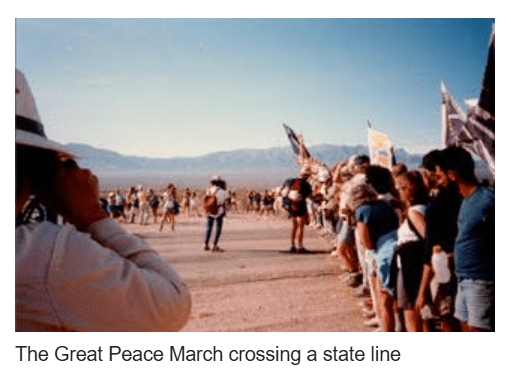
If someone had told me in 1986 that the Soviet Union would be gone within 10 years, I would’ve thought they were crazier than I was. In 1986, I was marching on Washington to petition for global nuclear disarmament (of the verifiable and bilateral kind). I was marching with a few hundred other people, so not a huge march. We were marching from Los Angeles (yes, California) to Washington (yes, DC) a march of over 3500 miles that would take about 9 months to complete. Crazy? Absolutely, but the nuclear arms race between the US and USSR was kind of making me crazy.
Estimates at the time put the world’s nuclear arsenal at around 54,000 nuclear warheads with destructive payloads of up to 100 megatons or more each. (One megaton is 50 times more powerful than the bomb dropped on Nagasaki.) That’s many times more than enough deadly force to kill all humans on the planet. In fact, people coined the word “overkill” to describe the indescribable potential of these weapons. At the time, I knew that the early warning system could give me 30 minutes notice of Armageddon. How do you plan for the future when your future is only the next 30 minutes? What sort of life can you build if it can all go up in smoke tomorrow?
As my friend on the March said, “It seemed like the least crazy thing I could do was walk across the country.” Maybe people along the way would listen. Maybe we could have a conversation. Maybe we could do something to stop the madness. None of us thought we would arrive in DC and, magically, the world would suddenly decide to eliminate nuclear weapons. But what else could we do to change people’s minds?
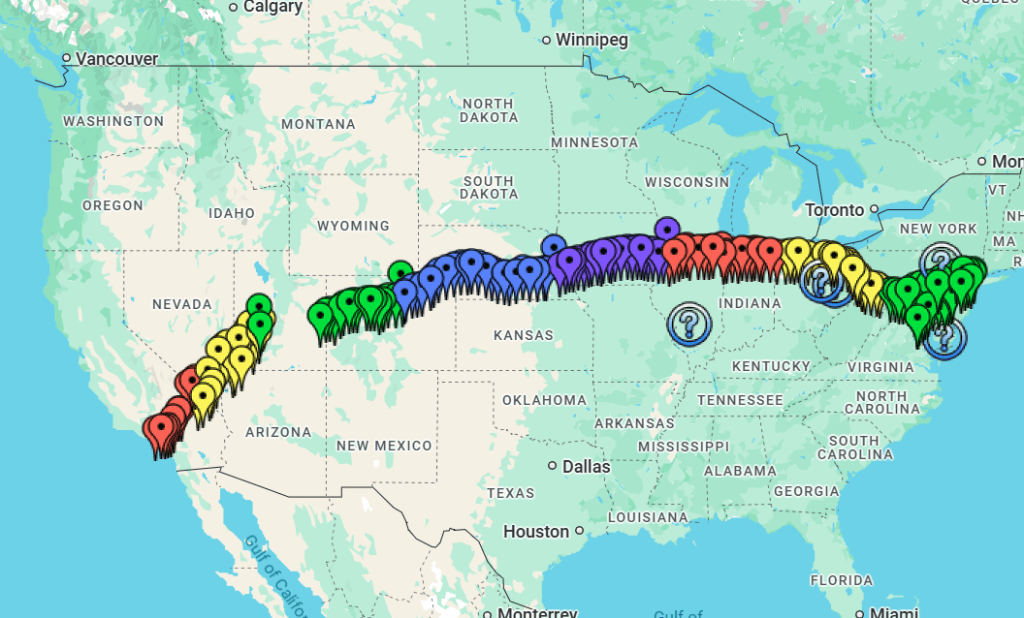
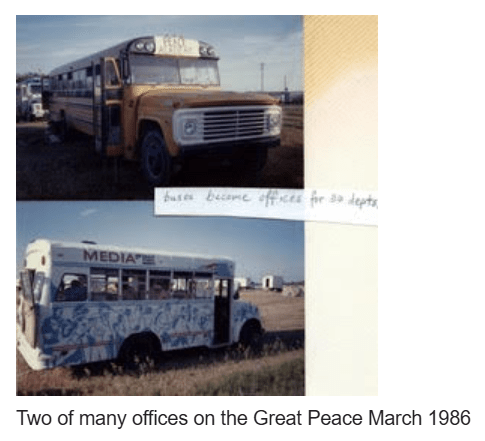
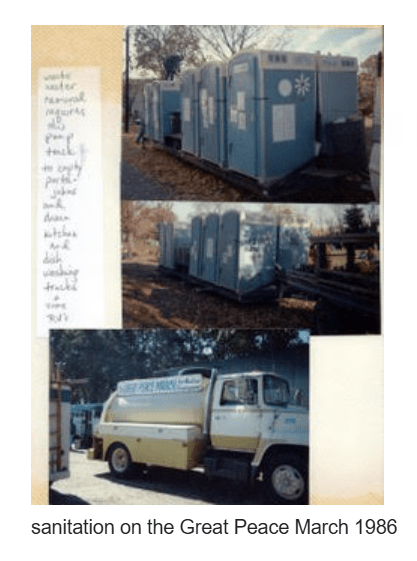
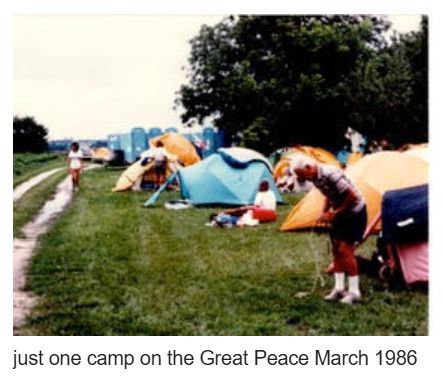
So we walked. The 12-mile days slid by easily. The 26-mile days beat me down, especially in the flat hot humidity of Nebraska highways. A Dairy Queen would cause spontaneous celebration. The next camp might be a cornfield, or a parking lot, or a high school, or a churchyard, or a park. All my clothing and personal belongings fit into a back pack and two milk crates hauled in a tractor trailer with my sleeping bag and our tents. The water we needed was hauled in tanks. Our porta-potties followed us down the road with 10 units mounted on each of 2 flatbed trailers. Numerous vehicles constituted the small town we called Peace City: a library/post office, a school bus (with a real school in it for the children), a kitchen, a repair shop, a wastewater tanker, a communications trailer, and even an Office of the Mayor in a conversion van.
Turns out, 1986 was the peak of the world’s nuclear arms race. Since the March, the number of nuclear weapons has gradually declined. Coincidence? Probably.
If someone had told me in 1986 that we would still have nuclear weapons in 2024, I wouldn’t have believed it. I knew–just knew—that if we didn’t get rid of them soon something would happen, maybe accidentally, but something would touch them off and start a nuclear war. Yet, here we are. It’s kind of a miracle. If someone had told me then that the world would someday declare nuclear weapons illegal by international law, it would have filled with hope that life was worth living after all, whatever it took.
And here is the Treaty on the Prohibition of Nuclear Weapons, entered into force on 22 January 2021. Amazing! https://disarmament.unoda.org/wmd/nuclear/tpnw/
And yet, it’s still mostly a symbolic gesture, sort of like a 3500-mile March on Washington. Right now, in 2024, our country proposes to ramp up the arms race again with the new Sentinel program. There’s no longer the excuse of the Soviet Union to justify an arms buildup, but here we go again. Why are we doing this? You can see the glint in the eyes of the contractors and subcontractors crowding the trough. Crazy. You and I are going to pay for it. Will we go bankrupt the way the USSR did?
If someone told me in 2024 that the US would be bankrupt within 10 years from overspending on military, would I believe it or would I think it was crazy? I don’t know. I’m not as sure about things as I was in 1986.
–Donna Williams
Categories: Events
 Great Falls Rising